
The year was 1964. It was the height of the Cold War between the United States of America and the Soyuz Sovyetskikh Sotsialisticheskikh Respublik, or CCCP to the Russians (USSR to the Americans). The US had already been involved in the dirty, real war between North and South Vietnam for many years, but the escalation of troop involvement with “boots on the ground” wouldn’t happen for another year. Two years had passed since the Cuban Missile Crisis, and President John F. Kennedy had recently been assassinated at the end of 1963. The US Surgeon General issued the first report that smoking might be hazardous to one’s health. Cassius Clay, who had recently beaten Sonny Liston to take the heavyweight title, changed his name to Muhammad Ali. The ESRO (what would later become the European Space Agency) was established to pursue scientific research in space. The most powerful earthquake recorded in North American history, at a magnitude of 9.2, occurred in southern Alaska, killing 125 people and causing extensive damage to the city of Anchorage. Sidney Poitier became the first African-American actor to be awarded the Academy Award for Best Actor in a Leading Role. Four years later Martin Luther King Jr. would be assassinated while standing on the balcony of room 306 at the Lorraine Motel in Memphis, Tennessee.
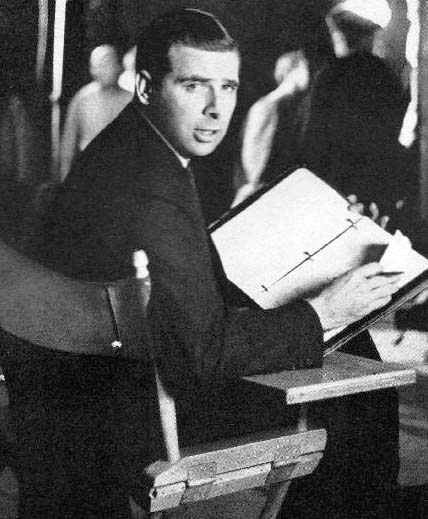
It was also during the year 1964 that a former World War II B-17 bomber pilot in the Pacific Theater, Pan American World Airways pilot, Los Angeles police officer, and successful television writer of 1950s Westerns, would exchange six-shooters for phasers. The man was Gene Roddenberry. He was a fan of science fiction and had written a concept for a new TV show set in space. He submitted his idea to Desilu Productions, and they liked what they saw. He and Desilu just needed to find a network that would be willing to put the show on the air. NBC agreed to pay most of the costs and air the pilot episode. After that, as they say, “the rest is history.” I’m glossing over the fact that the first pilot wasn’t well-liked, so they ended up making a second pilot with different actors, but that’s all in the details if you want to go read about it elsewhere. After approving the second pilot, the new show was to be slotted into NBC’s broadcast lineup for the 1966 season, and the show was to be called “Star Trek.”
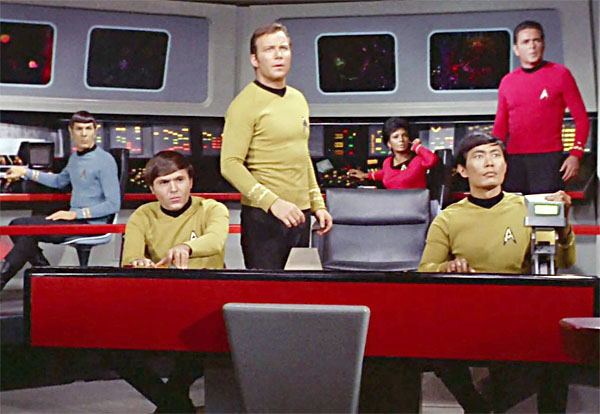
Though the world around him was full of racism, bigotry, and xenophobia, not to mention the Cold War fallout shelters, the show that Gene Roddenberry imagined and ultimately created offered a much different view of mankind in the future. Rather than displaying a hatred toward the Russians (who the US were not on friendly terms with in any sense of the word) and the Asians (the US had fought the Japanese in WWII, against the North Koreans, backed by both China and the Soviet Union, in the early 1950s, and at the time in 1964, the Chinese government was currently backing the North Vietnamese), the bridge crew of the starship Enterprise included likable Russian and Asian crew members, Ensign Pavel Chekov and Lieutenant Hikaru Sulu. Rather than portraying an African-American woman as a second-class citizen (as they typically were in the society of the day), on the starship Enterprise she was the intelligent, sexy polyglot and communications officer, Nyota Uhura. Though there was no hatred toward the Scottish people at the time (that I know of), we even had a likable chief engineer, Montgomery Scott, with a Scottish accent. To top it all off, the First Officer of the ship was a pointy-eared, green-blooded alien from the planet Vulcan, Mr. Spock. Gene Roddenberry wanted the show to reflect a crew with cooperative racial diversity at its finest. Remember, this was all presented as a conceptual television show in early 1964… a few months before the Civil Rights Act was enacted, making it legal for a black man to drink water from a previously “whites only” drinking fountain.
During its unfortunately (IMHO) limited run of only three seasons, 1966, 1967, and 1968, the show addressed many controversial topics of the times (and even some that are still present today), and made some positive first moves against bigotry. The first interracial kiss on television between a white man and a black woman (Captain Kirk and Lieutenant Uhura) happened on Star Trek. Some of the issues addressed by the show in addition to racism/bigotry, included war and peace, authoritarianism, imperialism, human rights, sexism and feminism, class warfare, economics, religion, and the role of technology in society. There is something subtle underlying the theme of the show, and that is that the society in the future has apparently done away with greed and the “what’s in it for me?” mentality. Everyone in “Starfleet” (the governing body) seems to be working together for the common good. Gene also imagined that the food of the future would be “interesting,” to say the least. In TOS (“The Original Series,” a term coined after the spinoffs started coming out), the food on the ship is portrayed as colored cubes, presumably little cubes of nourishment that would provide the necessary nutrition and energy to support humanity. To head off contradictions by fellow Trekkers, I’ll qualify that, again, this is in The Original Series. Once we get to The Next Generation and food replicators, all bets are off (“tea, Earl Grey, hot…”).
Looking back, Gene Roddenberry’s original concept of a future society was “fascinating” (as Mr. Spock might say) for the times. The show Star Trek was all imagined over SIXTY YEARS AGO as of this year. Millions of people have watched and fallen in love with the Star Trek franchise since then. So, whatever happened to Mr. Roddenberry’s ideal? While I’m not sure I would be excited about eating little colored cubes for every meal… I am positive that I would love to live in a progressive society that has “eyes on the future” (instead of sending us back to the past… my apologies, I couldn’t resist a little dig at the outcome of the 2024 US presidential election). A society without bigotry and racism, without class warfare (the “1 percenters” against the rest of us), without the need for religion, without glass ceilings for women and controversy over what women can and cannot do with their own bodies, without hatred toward someone because of their sexual orientation, without war, and without feeling the need to gain as much of “the almighty dollar” as we can get, for every citizen to be respected and live comfortably. Instead of embracing some of these concepts idealized many years ago, even before Gene Roddenberry, mankind still seems bent on hatred and destroying itself. Why, I ask? Why?
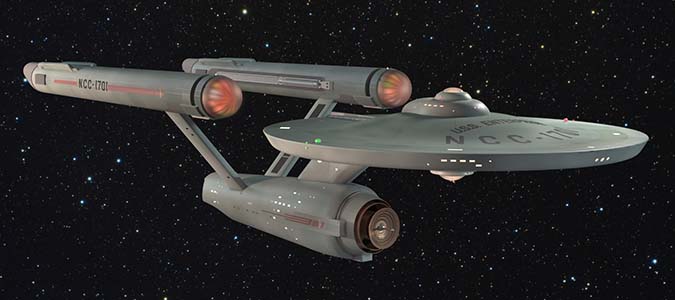
It is my firm opinion that until mankind DOES put aside all the petty bullshit, we will remain an insignificant speck in the corner of the Milky Way Galaxy. We earthlings seem hellbent on destroying the only habitable planet that we know of in this little area of space, and hellbent on destroying other societies on our planet that don’t seem to measure up to our own little ideas of what humankind should be like. If we would all just gather on earth for a big group hug, share some of the resources that the “privileged” own with those who are less fortunate, start protecting our planet and natural resources, and join together as “humans” (no race, sex, color, religions, etc.) for the common good, we might just survive, if not succeed, and become a spacefaring race capable and worthy of traveling through the stars like Gene imagined.
PA

 The Pondering Absurdist
Leave a comment